
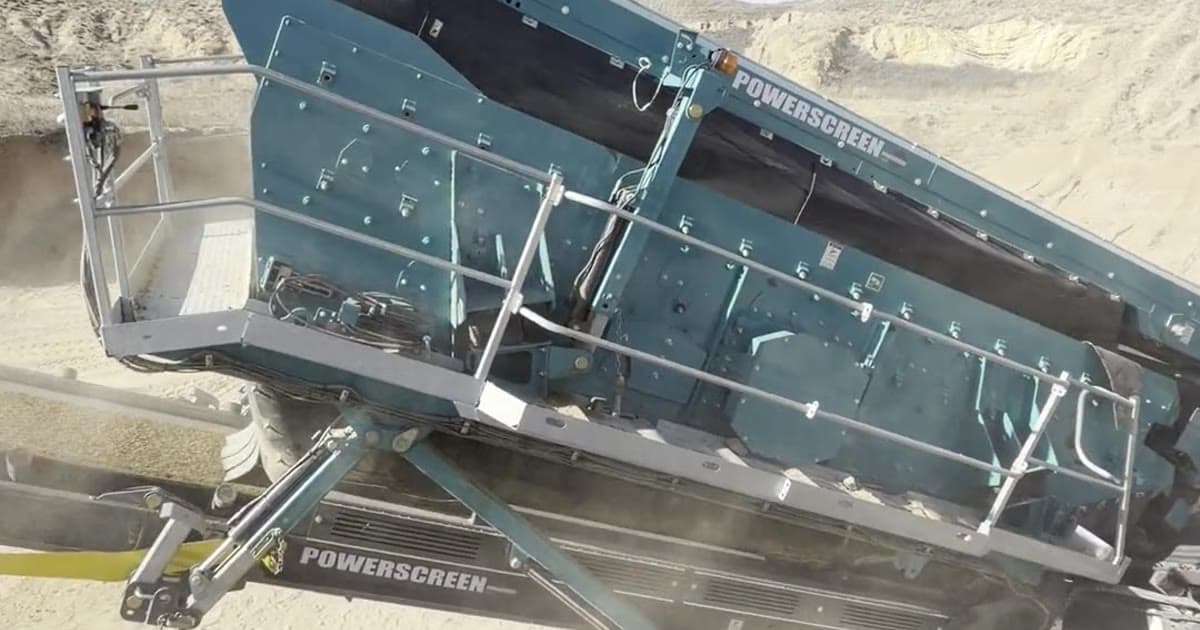
Crushing looks simple from the outside: big rock goes in, smaller rock comes out.
In a real aggregate operation, it is more controlled than that. Crushing is the first major mechanical step that turns blasted rock, excavated stone, gravel, recycled concrete, or asphalt rubble into usable construction material. The goal is not just to make rock smaller. The goal is to produce the right size range, the right particle shape, the right amount of fines, and a product that can be screened, washed, blended, stockpiled, loaded, and delivered without drifting out of spec.
That is why two piles that both look like "crushed stone" can perform very differently. One may be clean and open-graded for drainage. Another may include fines so it compacts tightly as a base. Another may need a controlled cubical shape for concrete or asphalt. The crushing process influences all of those outcomes.
This guide explains the major stages of rock crushing, the main crusher types, and the operating decisions that affect product quality.
Crushing Is Part Of The Whole Aggregate Process
Crushing does not happen in isolation. It sits between geology and finished product.
Before the first crusher ever touches the rock, the deposit already matters. Limestone, granite, basalt, sandstone, river gravel, recycled concrete, and reclaimed asphalt all break differently. Hardness, abrasiveness, moisture, clay content, bedding planes, and natural fractures affect how much energy is needed and what shape the particles become when they break.
In a quarry, blasting is also part of the size-reduction process. A good blast breaks rock into a muck pile that can be safely loaded and fed into the plant. A poor blast can leave too many oversized boulders, which slows the primary crusher, increases secondary breaking, and creates uneven feed. In a sand and gravel operation, the feed may come from excavation instead of blasting, but the same principle applies: the plant can only perform well if the incoming material is reasonably controlled.
After crushing, the material normally moves to screens. Screens separate particles by size. Oversize material may return to a crusher for another pass. Finished-size material may go to a stockpile, a wash plant, a blending system, or loadout. Conveyors, feeders, surge piles, magnets, dust controls, scales, and sampling systems all help keep the process steady.
The crusher is important, but it is one component in a larger circuit.
The Basic Goal: Controlled Size Reduction
Every crusher applies energy to rock until internal bonds or planes of weakness fail. That breakage can happen mainly by compression, impact, attrition, or some mix of all three.
The amount of size reduction is often described as a reduction ratio. In plain terms, it compares the feed size to the product size. Reducing 12-inch rock to 2-inch stone is a 6-to-1 reduction. No crusher can do unlimited reduction efficiently. If an operator tries to force too much reduction in one machine, the result is often excess wear, excess fines, lower throughput, poor shape, or all of the above.
That is why aggregate plants usually reduce rock in stages. Each stage does a reasonable amount of work, then screens or transfers the material before the next stage. Spreading the work across stages gives the producer more control over product size, shape, and cost per ton.
Primary Crushing
Primary crushing is the first mechanical reduction stage. It handles the largest feed, often shot rock or large excavated stone.
The primary crusher's job is usually not to make a finished product. Its job is to reduce large material to a size that can move safely on conveyors or haul trucks and can be processed by secondary equipment. In many aggregate plants, that means reducing several-foot rock down to a broad range that may be roughly several inches across, depending on the plant and product needs.
Primary crushers must be rugged. They deal with variable feed, oversize pieces, tramp material, surges from loaders or haul trucks, and changes in the face or pit. The most common primary crushers are jaw crushers and gyratory crushers. Horizontal shaft impact crushers can also be used in primary service when the rock is softer and less abrasive.
The primary stage affects everything downstream. If the primary crusher is starved, blocked, or fed unevenly, the secondary and tertiary stages feel it. If too much fines or undersize material is sent through the primary crusher unnecessarily, the plant may waste energy crushing material that was already small enough to bypass the machine.
For that reason, many primary systems use a grizzly feeder or scalping screen. This lets smaller material bypass the crusher while larger material goes into the chamber. Done correctly, that improves capacity, reduces wear, and helps stabilize feed to the rest of the plant.
Secondary Crushing
Secondary crushing takes the primary product and reduces it further. This is where the plant starts to aim more directly at usable aggregate sizes.
Secondary crushers commonly include cone crushers and horizontal shaft impact crushers. A secondary cone may be used when the material is hard or abrasive and the operation needs durable, efficient reduction. An HSI may be used where impact breakage gives better shape, higher reduction, or better performance with softer stone.
Secondary crushing is often paired with screening. Material that is already small enough can be removed as product or sent to another part of the plant. Oversize can continue through the circuit. This matters because it prevents unnecessary crushing and gives better control over final gradation.
For many base and coarse aggregate products, the secondary stage does much of the heavy lifting. It can influence whether a product has enough fractured faces, whether it contains too many flat and elongated pieces, and how much fine material is created.
Tertiary And Final Crushing
Tertiary crushing is the finishing stage in many plants. It is used when the operation needs smaller aggregate, manufactured sand, tighter gradation, or improved particle shape.
Common tertiary crushers include cone crushers, vertical shaft impact crushers, and sometimes additional impact or roll crushers depending on the material and target product.
At this point, the plant may run in closed circuit. That means material is screened after crushing. Finished-size particles leave the circuit, while oversize returns to the crusher. Closed-circuit crushing can improve control because the crusher keeps working only on the material that still needs reduction.
Tertiary crushing is especially important when the final product has stricter quality requirements. Concrete and asphalt aggregates often need controlled gradation and particle shape. Manufactured sand may need further processing to control excess dust or microfines. Specialty products may require even tighter size ranges.
In some plants, a fourth stage is added for very fine or highly controlled products. Most customer-facing aggregate products do not require that much explanation, but the point is useful: crushing is designed around the end product, not the other way around.
Jaw Crushers
Jaw crushers are compression crushers. Material enters an opening between a stationary jaw and a moving jaw. The moving jaw presses the rock against the fixed jaw, breaking it as it moves downward through a narrowing chamber.
Jaws are widely used as primary crushers because they are simple, strong, and able to accept large feed. They can handle many rock types, from limestone to harder stone, and are common in both stationary and mobile plants.
A jaw crusher tends to be a good fit when the operation needs a dependable first reduction step. Its limitations show up when very high capacity is needed or when product shape is the main goal. A jaw can make usable aggregate, but the primary purpose is usually to prepare feed for the next stage.
Key operating concerns include feed size, feed consistency, jaw die selection, discharge setting, and keeping the chamber from bridging. Oversize pieces can lodge in the opening. Poor feeding can wear the chamber unevenly. A well-fed jaw with the right setting will perform far better than a jaw that is alternately overloaded and starved.
Gyratory Crushers
Gyratory crushers are also compression crushers. A mantle rotates within a concave chamber, continuously compressing rock as it moves downward.
The main advantage of a gyratory crusher is capacity. Because it crushes continuously and has a large discharge area, it is common in large, high-tonnage operations. A primary gyratory can be built into a large stationary plant where haul trucks dump directly into the feed hopper.
That strength comes with cost and infrastructure. Gyratories are large machines, often requiring major foundations and plant design around them. For smaller or more mobile operations, a jaw crusher is often more practical.
When a quarry has high volume, long life, and consistent feed, a gyratory primary may make sense. When the operation is temporary, smaller, or changes location often, portable or mobile primary equipment may be a better fit.
Cone Crushers
Cone crushers are compression crushers used mostly in secondary, tertiary, and sometimes quaternary stages. They use a rotating mantle inside a bowl liner. Rock is squeezed and fractured as it moves through the chamber.
Cones are common in aggregate plants because they can process hard and abrasive stone efficiently. They can produce good cubical shape when they are correctly selected and operated. They are also adjustable, which lets operators control product size by changing the closed-side setting.
The closed-side setting, often called CSS, is the narrowest gap the rock must pass through before leaving the crusher. A tighter CSS usually makes finer product, but it can also increase power draw, wear, and the chance of packing or stalling. A wider setting may increase capacity but produce a coarser product.
Cone crushers are sensitive to feed conditions. They generally perform best with a steady, full chamber. This is often called choke feeding. If a cone is underfed, rock can bounce instead of compressing properly, which can hurt shape and create uneven wear. If feed is segregated, with coarse material on one side and fines on the other, the chamber wears unevenly and product quality suffers.
Good cone operation depends on matching the chamber to the feed, controlling feed rate, distributing material evenly, monitoring liner wear, and making adjustments before the product drifts out of spec.
Impact Crushers: HSI And VSI
Impact crushers break rock by striking it at high speed. Instead of slowly squeezing rock between surfaces, they accelerate material into blow bars, aprons, anvils, or a rock-lined crushing zone.
Horizontal shaft impact crushers, or HSIs, have a horizontal rotor with blow bars. They are often used with softer, less abrasive material, although they can also serve in secondary applications with harder stone in the right setup. HSIs are valued for high reduction and cubical product shape. They can be especially useful with limestone, recycled concrete, reclaimed asphalt, and other materials where impact breakage performs well.
Vertical shaft impact crushers, or VSIs, are often used in tertiary or final shaping applications. A VSI accelerates rock outward from a vertical rotor. Depending on the design, material may hit metal anvils or collide with a rock bed. Rock-on-rock VSI crushing can improve shape while limiting metal wear in some applications.
Impact crushing can make an excellent cubical product, but it is not always the lowest-cost option. Abrasive stone can wear blow bars, liners, anvils, and other parts quickly. Feed moisture, feed size, rotor speed, and the amount of fine material in the feed all affect performance.
For many operations, the choice between cone and impact crushing is a tradeoff between wear cost, reduction ratio, product shape, fines, and the nature of the stone.
Roll Crushers And Hammermills
Roll crushers use rotating drums to compress material between them. They are not as common as jaws, cones, and impacts in many modern aggregate circuits, but they can be useful when the operation needs a close product distribution or wants to limit fines in certain chip-stone applications.
Hammermills are related to impact crushers but use swinging hammers and often a grate system. Material must pass through the grate before leaving, which helps control product size. Hammermills are more common with softer, low-abrasion materials or industrial applications.
The important point is that no crusher type is universally best. The right machine depends on the feed, target product, throughput, wear cost, moisture, available space, and how the crusher fits the rest of the plant.
Particle Shape: Why Cubical Stone Matters
Particle shape is one of the most important quality outcomes of crushing.
Cubical particles tend to interlock well and perform better in many concrete, asphalt, and base applications. Flat and elongated particles can be harder to compact uniformly, may break under load, and can create problems in mixes that need predictable performance.
Shape is influenced by rock type, reduction ratio, crusher type, feed size, chamber design, and whether the material is crushed in one hard pass or gradually across multiple stages. Impact crushers often produce strong cubical shape because particles break along natural weaknesses under high-speed impact. Cone crushers can also produce good shape when properly choke-fed, correctly set, and operated in a well-designed circuit.
One common mistake is thinking shape is controlled only by the final crusher. In reality, the entire flow matters. Blasting affects feed size. Primary crushing affects what reaches the secondary stage. Screening removes properly sized material before it is over-crushed. Surge piles and feeders control whether the next crusher gets a steady diet. The final product is the result of the whole process.
Fines: Useful In One Product, A Problem In Another
Fines are small particles created during crushing, screening, handling, and sometimes washing. Whether fines are good or bad depends on the product.
For a compactable base, fines can be necessary. They fill voids between larger particles and help the material lock together under compaction. That is why products like crusher run, road base, or AB-3 are intentionally produced with a range of sizes down to fines.
For drainage stone, decorative stone, or clean concrete aggregate, too many fines can be a problem. Fines can hold water, track mud, reduce void space, dull the look of decorative stone, and interfere with drainage. For washed products, fines and dust may be removed after crushing and screening.
Crushing strategy affects fines production. High reduction ratios, excessive recirculation, poor screening, worn liners, wet or sticky feed, and over-crushing can all increase unwanted fines. If a plant is trying to make clean, coarse aggregate, it usually wants to remove finished-size material as soon as possible and avoid crushing it again.
This is one reason a well-designed circuit uses screens and closed loops carefully. Screens are not just sorting machines. They protect product quality by deciding what should be crushed again and what should leave the circuit.
Feed Control Is Product Control
Many crushing problems are really feed problems.
A crusher needs the right amount of material, delivered consistently, with the right size distribution. Sudden surges can overload the machine. Starving the machine can reduce crushing efficiency and hurt particle shape. Segregated feed can wear one side of the chamber faster than the other. Wet or sticky fines can build up and reduce capacity.
Feeders help regulate this. Vibrating grizzly feeders, pan feeders, belt feeders, and variable-speed systems meter material into the crusher. Scalping screens or grizzlies can remove undersize before crushing. Surge piles and bins can separate one stage from another so a short disruption in the primary stage does not immediately starve the secondary and tertiary stages.
Loader and excavator technique also matters. A loader may move volume quickly but may give the operator less visibility into oversize pieces in the bucket. An excavator can sometimes give better control of individual feed pieces. Either way, the operator feeding the plant has a major effect on uptime and product consistency.
Stationary, Portable, And Mobile Crushing
Crushing plants can be stationary, portable, or mobile.
Stationary plants are built for long-term, high-volume production. They can be engineered with strong foundations, permanent conveyors, surge systems, automation, dust controls, washing circuits, and loadout systems. When the deposit is long-lived and the production target is high, a stationary plant can offer lower long-term cost per ton.
The downside is capital cost and lack of mobility. A stationary plant is not easy to move. As the quarry face advances, haul distance may increase unless conveyors, mobile equipment, or in-pit crushing systems are added.
Portable plants are usually wheel-mounted and can be moved between sites or around a large project. Mobile tracked crushers can move closer to the face or around a jobsite. These systems are useful for short-term pits, contract crushing, demolition recycling, temporary production, or operations that need flexibility.
The tradeoff is often capacity and cost per ton. A portable or mobile spread may set up quickly and reduce trucking, but a large stationary plant may produce more tons per hour with more integrated controls. The best answer depends on the life of the project, product demand, permits, haul distance, and how often the operation needs to move.
Automation And Monitoring
Modern crushing systems increasingly use automation to improve safety, consistency, and equipment life.
Automation can sequence start-up and shutdown so conveyors, feeders, lubrication systems, and crushers operate in the right order. It can monitor amperage, oil temperature, vibration, crusher setting, cavity level, and other machine-health indicators. Some systems can adjust feed rate automatically to maintain a stable load.
This matters because crushing is dynamic. Material changes throughout the day. A new shot may be harder, wetter, finer, or more blocky than the previous one. Liners wear. Screens blind. Feeders drift. A plant that never adjusts will eventually drift away from its target.
Good automation does not replace experienced operators. It gives them better information and faster control. The best results come when operators understand the material and use monitoring data to make small corrections before they become large problems.
Useful things to track include:
- Crusher amperage or load
- Closed-side setting
- Feed rate
- Cavity level
- Oil temperature and pressure
- Vibration
- Liner wear
- Product gradation
- Screen efficiency
- Tons per hour
When those numbers change, the plant is saying something.
Maintenance Is Part Of Production
Crushers work in one of the toughest environments in construction materials. They deal with shock loads, abrasion, vibration, dust, heat, and constant movement of heavy rock. Maintenance is not separate from production. It is what keeps production possible.
Common maintenance priorities include checking lubrication systems, monitoring liners and wear parts, inspecting belts and guards, tightening fasteners, watching for unusual vibration, keeping material buildup under control, and documenting changes in performance.
Wear parts matter because they change the shape of the crushing chamber. As liners wear, the actual product size can drift even if the control setting looks correct. A crusher may also lose efficiency, draw more power, or produce a different shape. Waiting until product quality falls apart is usually more expensive than planning liner changes based on hours, tons, inspections, and gradation checks.
Manganese wear parts are common in jaw and cone crushers because they work-harden under impact. But manganese selection is not one-size-fits-all. Rock hardness, abrasion, crusher type, product size, and manufacturer recommendations all matter. The wrong wear part can shorten life, reduce capacity, or create unsafe conditions.
Daily inspection still matters even in automated plants. Small oil leaks, plugged spray bars, damaged belt skirting, loose guards, worn blow bars, uneven liner wear, and dust buildup are all easier to fix early than after they shut down the plant.
Safety Around Crushers
Crushers deserve respect. They handle large rock under high force, and blockages or maintenance tasks can put people in dangerous positions if procedures are not followed.
The person feeding the crusher needs training specific to that machine. Experience on a loader or one style of crusher does not automatically transfer to every machine. A jaw, cone, HSI, VSI, and mobile plant each have different feed limits, operating signs, clearing procedures, and maintenance hazards.
Basic safety practices include:
- Keep guards and safety devices in place.
- Follow lockout, tagout, and tryout procedures before maintenance or clearing.
- Do not enter a crusher chamber until the machine is fully shut down, isolated, and verified safe.
- Respect maximum feed size.
- Keep walkways and platforms clean.
- Monitor lubrication, pressure, temperature, and vibration.
- Train operators on the actual crusher they are using.
- Use manufacturer-approved lifting tools and procedures for wear parts.
Modern hydraulic systems can reduce manual intervention. Hydraulic chamber clearing, overload relief, and setting adjustment can help avoid situations where workers would otherwise need to work in or under the crusher. Those systems are not shortcuts around safety procedures. They are tools that must be maintained and used correctly.
Hydraulic Breaking And Oversize
Not every rock from the face is ready for the crusher. Oversize pieces may need to be broken before they can be loaded, hauled, or fed.
Hydraulic breakers are used to reduce oversize rock without requiring another blast. They may be mounted on excavators or fixed boom systems near the primary crusher. In the right setup, a breaker can improve uptime by clearing oversize before it blocks the crusher or slows the loading cycle.
Breaker selection depends on carrier size, hydraulic flow and pressure, rock type, required production, mounting package, tool type, and maintenance support. A breaker that is too large for the carrier can damage equipment and create unsafe conditions. A breaker that is too small may beat on the rock without transferring energy efficiently, increasing wear and wasting time.
Tool choice also matters. Chisel tools can concentrate force into cracks or seams. Blunt tools spread energy and can help shatter material when a seam is not available. Lubrication, retaining pins, bushings, hydraulic leaks, and loose bolts need regular inspection.
Hydraulic breaking is not the main event in aggregate production, but it can be the difference between smooth primary crushing and constant delays.
Why Crushing Quality Matters To The Customer
Most customers never see the crushing plant. They see the delivered material.
If the crushing process is controlled well, the product is more consistent. A clean crushed stone product drains better because excess fines are removed. A base material compacts better because the mix of coarse stone and fines is controlled. A concrete or asphalt aggregate performs better because gradation, fractured faces, and particle shape are within the target range.
If the process is poorly controlled, the product may vary from load to load. One load may be too fine. Another may be too coarse. One pile may compact well while another stays loose. Decorative stone may arrive dusty. Drainage stone may hold too much fine material. A job that should have been straightforward becomes harder in the field.
That is why product names are not enough. "One-inch crushed stone" or "crusher run" tells part of the story, but the actual gradation, cleanliness, source rock, and processing method determine how it will perform.
For engineered work, always follow the project specification. For non-engineered work, ask the practical questions:
- Does this product need to drain or compact?
- Is appearance important?
- Will it be exposed to traffic?
- Is a DOT, ASTM, KDOT, CDOT, NDOT, or project-specific gradation required?
- Does it need to be clean/washed?
- Are fines acceptable or required?
- Is the product being used as a base, surface, backfill, concrete aggregate, asphalt aggregate, or decorative stone?
Those answers point to the right material.
The Short Version
Crushing is not just breaking rock. It is controlled size reduction.
Primary crushing makes large rock manageable. Secondary crushing reduces and shapes it further. Tertiary crushing refines the product for tighter gradation, shape, or manufactured sand. Screens, feeders, surge piles, conveyors, washing systems, and stockpiles all influence the final material.
The best crushing circuits match the machine to the material, control feed, avoid unnecessary over-crushing, monitor gradation, maintain wear parts, and keep safety procedures at the center of the operation.
For customers, that shows up as better consistency: material that drains when it should drain, compacts when it should compact, and meets the size and quality requirements for the job.
Related Resources
Need help choosing crushed stone, clean stone, or compactable base for a project?