AB-3, often typed as AB3 in customer searches, is a compacting aggregate base material used for roads, driveways, pads, shoulders, and other places where the rock layer needs to support load and hold grade.
In plain English, AB-3 is not clean drainage stone. It is a dense, crushed base product with a controlled range of particle sizes, including fines. Those fines are part of the point. When AB-3 is placed at the right moisture and compacted correctly, the smaller particles fill the spaces between the larger particles and help the material tighten into a stable layer.
That makes AB-3 different from clean stone, decorative rock, pea gravel, or washed drainage rock.
This guide explains what AB-3 is, how it behaves, how specifications think about it, why gradation and plasticity matter, and what to ask before ordering it.
The Short Definition
AB-3 is an aggregate base product. In Kansas Department of Transportation language, Type AB-3 is a mechanically crushed aggregate base material with a required limestone or dolomite content and a gradation/plasticity band for aggregate base construction.
Outside a DOT specification, people may use "AB3" more loosely to mean a crushed limestone base, road base, crusher run, dense graded aggregate, or compacting gravel. That is why the product name should always be tied back to the intended use and, when available, the actual gradation.
The practical definition is:
AB-3 is a crushed, dense-graded base aggregate intended to compact and support traffic or construction loads.
What The "AB" Idea Means
AB stands for aggregate base in many local conversations, even though exact naming varies by agency and supplier. The important idea is that the product is not just a decorative rock size. It is a base-course material.
A base course sits below a surface course or final traffic layer and spreads loads into the subgrade. On a gravel driveway, the AB-3 may be both the base and the wearing surface. On a road, parking area, building pad, or construction entrance, it may support another layer above it.
That distinction matters because base aggregate is judged by performance. It must be strong enough, graded correctly, reasonably durable, and capable of compacting into a dense layer. The product is not selected mainly for color or appearance.
When AB-3 is used correctly, the larger particles carry structure, the smaller particles fill voids, and the compacted layer distributes wheel loads. When it is used incorrectly, it can still rut, pump, wash, or disappear into weak soil.
Why AB-3 Includes Fines
Fines are the smaller particles in the aggregate. In a clean drainage stone, too many fines can clog voids and reduce water flow. In a compacting base, controlled fines are useful.
A good base material needs particle packing. The larger particles create the stone skeleton. Intermediate particles fill some of the gaps. Fine particles fill smaller gaps. With proper moisture and compaction, the particle mass densifies.
That is why AB-3 and similar road-base products are not supposed to look like washed decorative stone. They often look dusty or gritty because they contain smaller crushed particles. Those particles help the material bind.
The key word is controlled. Too little fine material can leave the base loose and hard to lock together. Too much fine material can make the material water-sensitive, muddy, or prone to pumping. Clay-like fines can be especially problematic because they hold water and can reduce strength.
AB-3 Versus Clean Stone
Clean stone is usually selected when drainage is the priority. It contains limited fines and leaves connected voids between the particles. Water can move through those voids more easily.
AB-3 is usually selected when compaction and load support are the priority. It contains a broader size range so the material can pack tightly.
That creates the basic choice:
- Clean stone: better drainage, less compaction lock-up.
- AB-3 or road base: better compaction, less free drainage.
Neither material is universally better. The right product depends on the layer's job.
If the job is a French drain, retaining wall drainage zone, or open drainage layer, AB-3 is usually the wrong starting point because the fines work against flow. If the job is a driveway base, equipment pad, access road, or road shoulder, clean stone alone may shift under traffic and fail to create a dense surface.
AB-3 Versus Crusher Run
"Crusher run" is a broad field term. It usually means crushed stone that includes everything from the crusher output down through fines, often screened or processed to a target top size. In many markets, crusher run behaves like a compacting base material.
AB-3 and crusher run can be similar in behavior, but they are not automatically identical. AB-3 may refer to a specific state or agency specification. Crusher run may be a supplier product name without the same formal gradation or quality requirements.
If a project says AB-3, use a product that matches the project requirement. If a project says crusher run, ask what gradation or top size is expected. If the project has no written spec, describe the application and choose based on behavior: compacting base versus clean drainage.
AB-3 Versus Road Base
"Road base" is another broad term. It can refer to many dense graded aggregates used under roads, drives, lots, and pads. AB-3 is one type of road-base concept, especially in Kansas-style terminology.
Different agencies use different names: aggregate base, granular base, crushed aggregate base, dense graded aggregate, graded aggregate base, aggregate base course, base rock, shoulder aggregate, and more.
Because the names vary, sieve data matters. A road-base product should be judged by source, gradation, quality, plasticity, compaction behavior, and project approval, not just the label.
What A DOT Specification Controls
A formal aggregate base specification usually controls more than the product name.
It may define:
- Allowed source materials.
- Required crushing or fractured faces.
- Gradation limits by sieve.
- Maximum or allowed fine material.
- Plasticity index and liquid limit.
- Soundness or durability.
- Wear resistance, often through abrasion testing.
- Deleterious substances such as clay lumps, shale, organic material, roots, sticks, or foreign material.
- Stockpiling and handling requirements.
- Sampling and test methods.
This is why a DOT base product is not just "rock with dust." It is a controlled construction material.
For example, KDOT aggregate base construction requirements include different aggregate base types with percent retained requirements across multiple sieves, plus plasticity controls. KDOT also treats AB-3 as a mechanically crushed limestone or dolomite product with source and quality requirements. The exact table should be checked in the current project specification before bidding or ordering.
AB-3 In KDOT Terms
KDOT's aggregate base section is useful because it shows how specific a product name can become in a formal specification.
In that specification family, AB-1 and AB-2 can use different combinations of crushed stone, gravel, sand, sand-gravel, limestone gravel, soil, or qualified binder material. AB-3 is narrower: it is specified as a mechanically crushed product with a high limestone or dolomite content. The spec also includes quality requirements such as soundness and wear, plus product-control requirements for gradation and plasticity.
For a buyer, that does not mean every local "AB-3" conversation is automatically a KDOT project. It means the formal version of the product is data-driven. A true specification controls source, gradation, quality, deleterious material, stockpiling, and test method. A casual product nickname does not.
If your job is public, engineered, inspected, or tied to a bid document, confirm whether "AB-3" means the KDOT type, a city/county equivalent, or a supplier's local road-base product.
Gradation Is The Heart Of AB-3
Gradation is the distribution of particle sizes. For AB-3, gradation controls how the material packs, supports load, and responds to water.
A dense base needs a range of sizes. If almost everything is one size, the material has large voids and can shift. If the material contains a smooth distribution from coarse particles down through controlled fines, it can compact into a denser layer.
In a sieve analysis, AB-3 will usually show material spread across several sieves rather than dropping sharply like a clean one-size stone. The curve should not be random. It should fit the specified band.
This is one reason blend control matters. A producer may need to combine crusher output, screenings, or other fractions to keep the base inside the required gradation band.
Why Percent Retained And Percent Passing Both Show Up
Some aggregate specifications are written as percent passing. Others are written as percent retained. Both describe the same gradation from different directions.
Percent passing tells you how much material is smaller than a sieve opening. Percent retained tells you how much material stays on that sieve. Cumulative retained tells you how much has been caught on that sieve and all larger sieves.
For AB-3 and other base materials, this matters because one table may not look like another even when the underlying gradation concept is similar. A supplier, contractor, or calculator may need to convert between formats before comparing a product to a target band.
The safe rule is to put every material in the same format before making decisions. Do not compare a percent retained table directly to a percent passing chart without converting it.
A Good Base Gradation Is Not Just A Smooth Curve
People often say "well graded" to mean the material has a smooth distribution from coarse to fine. That is mostly right, but it can be oversimplified.
A base product needs enough coarse material to create a load-bearing skeleton. It needs intermediate sizes to reduce large gaps. It needs controlled fines to fill smaller voids and help the layer compact. But it also needs to avoid too many water-sensitive fines.
That balance is application-specific. A very open gradation may drain well but move under traffic. An overly fine gradation may grade smoothly but hold water and lose strength. A gap-graded product may have coarse and fine material but lack the middle sizes needed for uniform density.
The goal is not a pretty curve for its own sake. The goal is a gradation that produces density, stability, constructability, and durability under the expected traffic and moisture conditions.
The No. 200 Sieve Matters
The No. 200 sieve measures very fine material. Material passing the No. 200 can include rock dust, silt, and clay-sized particles.
For AB-3, some fine material may help density. But too much very fine material, or fines with high plasticity, can create problems. The material may absorb water, become soft, pump under traffic, or lose support during wet periods.
Specifications often include limits on the No. 200 fraction and plasticity because those values help control moisture sensitivity. KDOT's aggregate base table, for example, includes No. 200 limits and plasticity/liquid-limit controls for base materials.
For a buyer, this means "dusty" is not automatically bad, but uncontrolled fines are. A proper base product is engineered around a gradation range, not guessed by appearance.
The No. 40 And No. 200 Relationship
Base specifications sometimes look at the relationship between very fine material and the broader fine fraction. The reason is practical: not all fines behave the same, and the amount of minus No. 200 material relative to the material passing larger fine sieves can signal whether the base may be too silty, dusty, or plastic.
The No. 40 sieve is commonly associated with the fine fraction used in Atterberg limit and plasticity testing. The No. 200 sieve captures the very fine part that can control water behavior. If a base has a high amount passing No. 200, especially with plastic clay minerals, it may become more moisture sensitive.
For normal customers, the important point is not the exact lab procedure. It is that a proper AB-3-type base is controlled in the fine end. The dust is not random. It has limits because those small particles control how the base behaves when wet.
Plasticity: Why Clay Fines Are Different
Plasticity describes how fine-grained material behaves with water. Clay-like fines can attract and hold water, become sticky, and change strength as moisture changes. Silt and clean rock dust may behave differently.
That is why base specifications often care about plasticity index and liquid limit. These are not decorative concerns. They help identify whether the fine fraction may become water-sensitive.
A base can have the same percent passing No. 200 as another base but behave differently if the fines are clayey in one product and mostly nonplastic rock dust in the other.
On a job site, plastic fines may show up as pumping, rutting, mud, or a surface that never tightens properly after wet weather.
Compaction Is Part Of The Product
AB-3 is not finished when it is dumped.
It needs to be placed, moisture-conditioned if necessary, graded, and compacted in lifts appropriate for the project and equipment. If the material is too thick in one lift, the top may look tight while the lower portion remains loose. If it is too dry, particles may not seat. If it is too wet, it may shove, pump, or rut.
The compaction method matters too. A pickup truck driving over a pile is not the same as controlled compaction with proper equipment. For driveways, parking areas, access roads, and pads, the difference between placed rock and compacted base is often the difference between a surface that lasts and one that ruts quickly.
Optimum Moisture Is Why Timing Matters
Base aggregate compacts best when its moisture content is close to the range that lets particles move and seat without pumping. Too dry, and the fines do not help the particles rearrange. Too wet, and the layer can shove, rut, or develop a slick surface under equipment.
This is why the same AB-3 can behave differently in July dust, after a rain, or during a wet spring. The material did not become a different product. The moisture condition changed.
On controlled work, moisture-density testing gives a target. On smaller jobs, the practical version is to avoid compacting bone-dry material that will not tighten and avoid compacting saturated material that moves like mud. If the base is too dry, light watering may help. If it is too wet, drying time or correction of the water source may be needed.
Compaction is a construction process, not just a delivery event.
Lift Thickness And Equipment Size
AB-3 should be placed in lifts that the available equipment can compact. A thick lift can hide loose material below a tight-looking surface. Later traffic compresses the lower layer unevenly, and ruts appear.
Small residential equipment can compact thinner lifts than heavy rollers. A skid steer and plate compactor are useful tools, but they are not the same as a properly sized roller on a larger pad or road. The maximum practical lift thickness depends on aggregate size, moisture, compactor energy, and project tolerance.
For driveways and pads, staged placement often produces a better result than dumping the full depth at once. Place, grade, moisture-condition if needed, compact, then repeat.
The Subgrade Is Usually The Real Limitation
AB-3 can be a strong base, but it cannot make weak soil disappear.
The subgrade is the soil or existing material under the aggregate layer. If the subgrade is soft, wet, organic, highly plastic, or inconsistent, the base can punch into it. The surface may rut even if the AB-3 itself is good.
Aggregate surfacing design references emphasize that rutting and punching failures often occur when the aggregate layer is too thin for the subgrade strength or when loose/soft soils are present. In other words, the base layer must be thick enough to spread loads before they reach weak soil.
For driveways and access roads, this means soft spots should be corrected before the AB-3 goes down. Sometimes that requires undercutting and replacement. Sometimes it requires geotextile separation or geogrid. Sometimes it requires drainage correction. Simply adding a thin layer of base on top of mud is rarely a durable fix.
Bearing Failure: Why Ruts Keep Returning
Ruts often come back because the base is too thin for the subgrade and the load.
When a tire load reaches the aggregate surface, stress spreads downward. If the aggregate layer is thick and compacted, the stress reaching the soil is lower. If the aggregate layer is thin, the stress reaches the soil in a smaller area and can exceed the soil's bearing strength. The soil shears or deforms. The wheel path sinks. Material may bulge beside the rut.
That is a bearing problem, not just a surface problem.
This explains why topdressing a rut with more rock may only be temporary. If the subgrade is still soft and the base is still too thin, the new material gets pushed into the same weak zone. A durable repair may require undercutting the weak soil, adding separation fabric, improving drainage, increasing thickness, or changing the traffic path.
Where Geotextile Helps AB-3
Geotextile is commonly used as a separator between weak/fine subgrade and aggregate base. It helps keep soil fines from pumping up into the base and helps keep aggregate from punching down into the soil.
That separation can preserve base thickness. It can also make construction easier over soft ground because the aggregate layer stays more distinct from the subgrade.
Geotextile is not a substitute for all thickness or drainage. It must be placed on prepared ground, overlapped correctly, and covered without tearing. Heavy rutting, sharp turns, or exposed fabric can damage it. But on soft clay or wet fine-grained soil, separation can be one of the most useful improvements in the section.
Geogrid is different. It is typically used for reinforcement or confinement rather than just separation. Some projects use both, depending on soil and load.
Water Control Still Matters
AB-3 is a compacting product, not a drainage product. But water still controls performance.
Surface water should be shed away from the drive, pad, or road. The base should not sit in a bathtub of trapped water. Ditches, crowning, slope, outlet points, underdrains, and edge support can all matter.
If water is allowed to saturate a fine-grained subgrade, traffic can cause pumping. Fine soil can move up into the base. The aggregate layer loses thickness and support. This is one place where geotextile can help by acting as a separator between soft subgrade soil and aggregate base.
The best base jobs usually combine the right aggregate with good drainage and good preparation.
Where AB-3 Is A Good Fit
AB-3 is commonly a good fit for:
- Driveway base layers.
- Gravel road base.
- Access roads.
- Construction entrances and job-site working surfaces.
- Equipment pads and staging pads.
- Parking area base where a compacted aggregate surface is appropriate.
- Shoulders and maintenance areas when the specification allows.
- Base under pavement, concrete, or other surfaces when the project detail calls for that material.
The exact use depends on the project specification, soil, drainage, traffic, and available local materials.
Where AB-3 Is Usually Not The Right Fit
AB-3 is usually not the right product for:
- French drains or open drainage trenches.
- Retaining wall drainage zones requiring clean stone.
- Decorative landscape beds where appearance matters.
- Areas where a clean, washed, low-fines stone is required.
- Pipe bedding when the project calls for a clean or uniformly graded product.
- Concrete or asphalt aggregate unless specifically designed and approved for that use.
The fines that make AB-3 compact can work against drainage and appearance.
AB-3 For Driveways
For gravel driveways, AB-3 or a similar compacting base is often used below the driving surface. The base layer supports traffic and helps resist rutting.
A durable driveway is usually a system:
- Stable subgrade.
- Separation fabric or geogrid if needed.
- Proper base thickness for the soil and traffic.
- Correct moisture and compaction.
- Crown or slope to shed water.
- Edge support where the drive meets shoulders or ditches.
- A surface layer selected for maintenance, appearance, and traction.
AB-3 can be the structural workhorse in that system, but it is not a substitute for drainage or subgrade repair.
AB-3 For Pads And Construction Access
Pads and construction entrances often need a stable working surface for heavy trucks and equipment. AB-3 can work well when the subgrade is prepared and the base thickness is adequate.
Heavy loads expose weak spots quickly. If the material is placed over soft clay or wet soil without separation, aggregate can disappear into the subgrade. The surface then ruts, pumps, and requires repeated topdressing.
For commercial work, it is worth treating the base as a designed layer rather than a cleanup item. The cost of proper preparation is often less than the cost of repeated repairs, stuck trucks, delayed concrete placements, or failed inspections.
AB-3 Under Concrete Or Asphalt
AB-3 or similar aggregate base may be used under pavement or slabs when the project detail calls for it. The purpose is usually to provide a stable working platform, uniform support, and a layer that can be graded and compacted before the final surface.
This does not mean any driveway base product is automatically acceptable under concrete or asphalt. Pavement and slab details may require a specific gradation, density, thickness, moisture condition, or proof roll. They may also require drainage layers, vapor barriers, or different base materials depending on the design.
If a concrete contractor, asphalt contractor, engineer, city, county, or DOT specification controls the job, follow that document. AB-3 is a good concept, but the actual approved base material is what matters.
AB-3 As A Wearing Surface
On many rural drives and work areas, AB-3 also serves as the surface. That can work, but it changes the maintenance expectations.
As a surface, AB-3 will be exposed to rain, tires, turning, snow removal, dust, and erosion. The fines that help the base compact can create dust in dry weather and can move during heavy runoff if the drive is not shaped correctly. The surface may need occasional grading, crown restoration, pothole repair, and topdressing.
For a cleaner decorative appearance, customers sometimes want to place clean stone over AB-3. That can look better, but clean stone may move under tires unless it is chosen and placed carefully. The base still does the structural work.
How AB-3 Is Produced
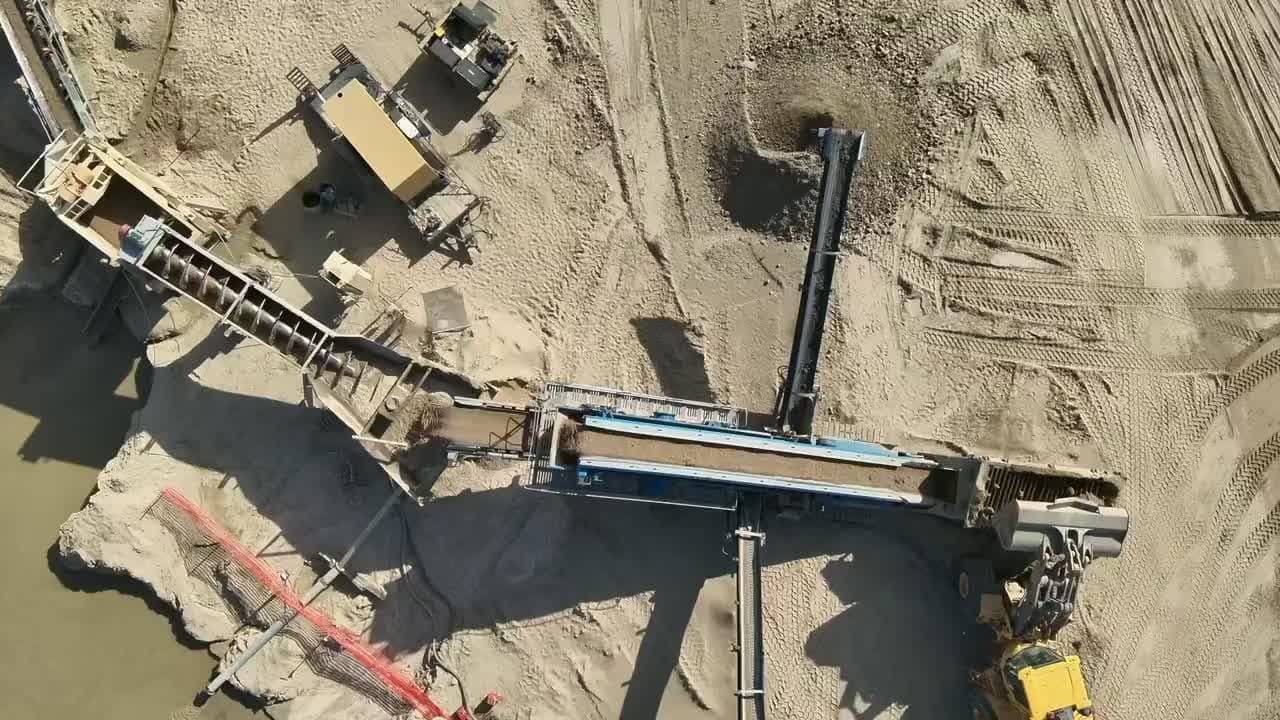
AB-3 begins with source rock, often limestone or dolomite in Kansas-style markets. The rock is crushed, screened, and sometimes blended so the final gradation falls within the required band.
Crushing creates angular particles. Angular faces help particles interlock better than rounded gravel. Screening separates size fractions. Blending or crusher adjustments help control the amount of coarse, intermediate, and fine material.
Stockpiling and handling matter. If the stockpile segregates, the delivered load may not represent the intended gradation. Good producers manage pile building, product separation, contamination, and testing.
Why Mechanical Crushing Matters
Mechanical crushing creates fractured faces. Fractured, angular particles tend to interlock better than naturally rounded gravel. That interlock is valuable in base because it helps resist movement under traffic.
A mechanically crushed limestone or dolomite base also produces fines from the same source rock. Those fines can help the material bind when controlled. A mixed pit-run material may not offer the same angularity, consistency, or fine-fraction behavior.
This does not mean every crushed product is automatically a good AB-3. Crushing is only part of the system. The producer still has to control top size, intermediate sizes, fines, plasticity, stockpiling, and contamination.
Stockpile Segregation Can Change Base Behavior
Dense graded aggregate contains many sizes, and those sizes can separate during handling.
When material is dropped into a pile, coarse particles tend to roll down the outside while finer particles stay closer to the drop point. If a loader digs only from one zone, one truck may receive a coarser load and another may receive a finer load. If adjacent piles are not separated, clean stone, base, sand, or soil can contaminate the product.
Good stockpile practice matters for AB-3 because the product's value is its gradation. A segregated load may not compact like the intended base. It may also fail a sample if the sample is taken from a nonrepresentative portion of the pile.
For small residential work, this usually shows up as variable appearance. For spec work, it is a quality-control issue.
What To Ask Before Ordering AB-3
Useful questions include:
- Is this product intended to meet AB-3 or another aggregate base specification?
- What is the source material?
- Is it crushed limestone, dolomite, gravel, or another aggregate?
- Is a current gradation available?
- Is it approved for the project or agency?
- Does the project require KDOT, city, county, or engineer approval?
- What top size is expected?
- Is the product compacting base or clean drainage stone?
- What quantity and delivery schedule are needed?
If you have a project spec, send it. Product names are not enough for spec work.
Ordering Notes
Bulk aggregate is freight-sensitive. Delivered pricing depends heavily on distance from the source, truck availability, quantity, and whether the material is stocked nearby.
For job-site planning, remember:
- Minimum order is 12 tons per product.
- One product ships per truckload.
- Multiple products require separate loads.
- Larger jobs may qualify for project pricing.
- Compaction and placement are separate from delivery unless arranged with a contractor.
If the project needs a specific approval or gradation, confirm before scheduling trucks.
The Bottom Line
AB-3 is a compacting aggregate base material. It is built around gradation, fines, plasticity control, source quality, and compaction.
Use AB-3 when the job needs a dense base that can support load and hold grade. Use clean stone when the job needs open drainage. If a project has a written specification, follow the specification rather than relying on a product name.
The best results come from matching the material to the application, preparing the subgrade, managing water, placing the base in reasonable lifts, and compacting it properly.