Aggregate looks local because it has to be local.
Crushed stone, sand, gravel, road base, and concrete aggregate are heavy, low-margin materials. Freight can become a large part of delivered cost. That means a good quarry is not just a place with rock. It is a place with the right rock, enough reserves, workable access, reasonable permitting risk, and a market close enough to justify the investment.
Choosing a quarry site is therefore both a geology problem and a business problem.
This guide explains how aggregate quarry and pit sites are evaluated, why regional geology matters, what testing is needed, and how the final plant design connects to the products customers buy.
A Quarry Starts With Market Demand
The first question is not only "Is there rock here?" The first question is "Is there a market that needs this rock?"
Aggregate demand comes from concrete, asphalt, road base, utility work, pads, drainage, landscaping, public infrastructure, and private development. A deposit far from demand may be geologically attractive but economically weak because trucking costs can make the delivered price uncompetitive.
Good site selection starts with the market area:
- Where are concrete plants, asphalt plants, contractors, road projects, subdivisions, utilities, and commercial construction?
- What aggregate sizes and specifications are needed locally?
- How far can trucks travel before freight dominates the delivered price?
- Are there competing sources closer to the work?
- Does the market need crushed stone, sand and gravel, base, riprap, specialty stone, or washed products?
The best quarry is often not the largest deposit. It is the deposit that can reliably serve the right products to the right market at the right delivered cost.
Geology Controls The Product
Aggregate quality begins with the deposit.
Limestone, dolomite, granite, basalt, sandstone, gravel, alluvial sand, glacial deposits, and recycled sources all behave differently. They break differently, polish differently, absorb water differently, and wear equipment differently. Some rock makes excellent base but may not meet a concrete or asphalt requirement. Some gravel may be rounded and attractive but not ideal for compacted base unless crushed. Some deposits contain clay, shale, organics, weak layers, or deleterious particles that limit use.
Geology affects:
- Crushing energy.
- Particle shape.
- Fines generation.
- Durability.
- Soundness.
- Abrasion resistance.
- Absorption.
- Chemical compatibility.
- Product mix.
- Waste percentage.
- Blasting behavior.
- Long-term consistency.
A quarry plan must understand the rock before designing the plant.
Sand And Gravel Deposits
Sand and gravel deposits are often formed by water, ice, or alluvial processes. Rivers, glacial meltwater, alluvial fans, terraces, and outwash deposits can sort particles into usable sand and gravel sizes.
These sources may require excavation, screening, washing, classifying, and sometimes crushing. Natural gravel can be rounded, which helps some concrete workability but reduces interlock for compacted road base unless the gravel is crushed.
Sand and gravel pits may have changing material across the property. One area may contain clean coarse gravel. Another may contain fine sand, silt, clay, or organics. The water table may be close to the surface. Processing and reclamation plans must account for those conditions.
Crushed Stone Deposits
Crushed stone quarries mine bedrock. The rock is drilled, blasted, loaded, hauled, crushed, screened, washed if needed, and stockpiled.
Bedrock quarries can produce a broad range of products from the same source: riprap, surge stone, clean stone, base, screenings, manufactured sand, concrete aggregate, asphalt aggregate, and specialty products. Whether the source can make those products depends on quality, ledge consistency, plant design, and market demand.
Crushed stone has one major advantage for many structural uses: angular particles. Angular crushed rock can interlock and compact better than rounded gravel, which is why it is common in base courses, pads, and road work.
Regional Geology Matters
The United States has very different aggregate geology by region.
Some areas have abundant limestone or dolomite near the surface. Others rely on granite, basalt, trap rock, sandstone, river gravel, glacial deposits, marine sand, or imported aggregate. Coastal plains may have different material availability than mountain regions. Glaciated regions may have sand and gravel deposits that do not exist in the same way elsewhere.
This regional variation is why product names can be misleading. A "road base" in one market may come from crushed limestone. In another, it may be crushed gravel. In another, it may be granite or recycled concrete. The name is only a shorthand. The source and gradation define performance.
Desktop Screening
Before expensive drilling or permitting, developers usually perform desktop screening.
This may include:
- Geologic maps.
- Soil maps.
- Aerial imagery.
- Lidar and topographic data.
- Existing quarry and pit locations.
- Parcel data.
- Zoning maps.
- Road and rail access.
- Floodplain and wetland data.
- Water resources.
- Nearby homes, schools, hospitals, or sensitive receptors.
- Utility availability.
- Land ownership and mineral rights.
- Environmental constraints.
The goal is to eliminate weak candidates early and focus field work on sites that could realistically become a permitted operation.
Field Exploration
If desktop review looks promising, field exploration begins.
For sand and gravel, exploration may include test pits, trenching, augering, drilling, sampling, and groundwater observations. The purpose is to understand thickness, gradation, fines content, clay seams, overburden, water table, and lateral variation.
For bedrock, exploration may include geologic mapping, core drilling, face observations, test blasting, bulk sampling, petrographic review, and lab testing. The team needs to understand ledge thickness, weathering, fractures, bedding, faults, overburden, groundwater, and quality changes with depth.
Exploration is not just about proving material exists. It is about proving the material can be produced consistently.
Geophysics And Electrical Resistivity
Some site-selection programs use geophysical methods such as electrical resistivity imaging. Electrical resistivity can help infer changes in subsurface materials because different rock, soil, moisture, and void conditions conduct electricity differently.
In aggregate exploration, resistivity can help identify bedrock depth, possible clay zones, saturated zones, or changes in deposit geometry. It is not a replacement for sampling and testing. It is a screening tool that can guide where to drill or trench.
Like every indirect method, it has limits. Results must be interpreted with local geology and verified with physical samples.
Laboratory Testing
Aggregate testing determines whether the source can meet intended uses.
Common evaluation areas include:
- Gradation.
- Specific gravity and absorption.
- Soundness.
- Abrasion or degradation resistance.
- Clay lumps and friable particles.
- Deleterious materials.
- Organic impurities for fine aggregate.
- Fractured faces.
- Flat and elongated particles.
- Alkali-silica reactivity where relevant.
- Plasticity and fines quality for base materials.
- Sand equivalent or other fine aggregate quality tests where specified.
The exact tests depend on the product. Concrete aggregate, asphalt aggregate, road base, riprap, drainage stone, and fill sand do not have the same requirements.
Reserve Quantity And Mine Life
A deposit must have enough usable material to justify development.
Reserve estimates consider:
- Property size.
- Mineable depth.
- Overburden thickness.
- Setbacks.
- Slopes and highwalls.
- Water table.
- Waste zones.
- Product yield.
- Processing losses.
- Permitted mining limits.
- Reclamation requirements.
It is not enough to calculate total rock volume. The operation needs recoverable, saleable reserve. If only part of the deposit makes spec products, the rest may become lower-value fill, waste, or material that requires blending.
Transportation Access
Aggregate is heavy. Transportation can decide whether a quarry succeeds.
A strong site needs practical access to the market. Truck routes must handle legal weights, turning movements, sight distance, bridges, intersections, school routes, neighborhoods, and seasonal restrictions. Rail can matter for large regional distribution, but many local aggregate deliveries move by truck.
Access affects:
- Delivered price.
- Truck cycle time.
- Community impacts.
- Road maintenance.
- Safety.
- Hours of operation.
- Permit conditions.
Two deposits with similar rock can have very different value if one has better access.
Zoning And Permitting
Permitting can be the hardest part of site selection.
A potential quarry may need zoning approval, conditional use permits, mining permits, stormwater permits, air permits, water permits, wetlands review, reclamation plans, traffic studies, noise and dust controls, blasting plans, and local public hearings. Requirements vary by state, county, city, and project.
Common issues include:
- Noise.
- Dust.
- Truck traffic.
- Blasting vibration and air overpressure.
- Groundwater.
- Surface water and stormwater.
- Wetlands and floodplains.
- Visual screening.
- Hours of operation.
- Property values and land-use compatibility.
- Reclamation and final land use.
Even a good deposit can fail if permitting risk is too high or community impacts cannot be managed.
Environmental Review
Aggregate operations interact with land, water, air, and neighboring properties.
A responsible site plan addresses stormwater, sediment control, dust control, fuel and chemical storage, wash-water management, noise, endangered species where applicable, wetlands, reclamation, and post-mining land use.
For sand and gravel operations, water table and pond design may matter. For crushed stone quarries, highwalls, benches, blasting, and groundwater inflow may matter. For wash plants, settling ponds, clarifiers, thickeners, or filter presses may be needed to manage fines and recycle water.
Environmental planning should happen before the site is built, not after problems appear.
Plant Type: Stationary, Portable, Or Mobile
Once the deposit and market are understood, plant design begins.
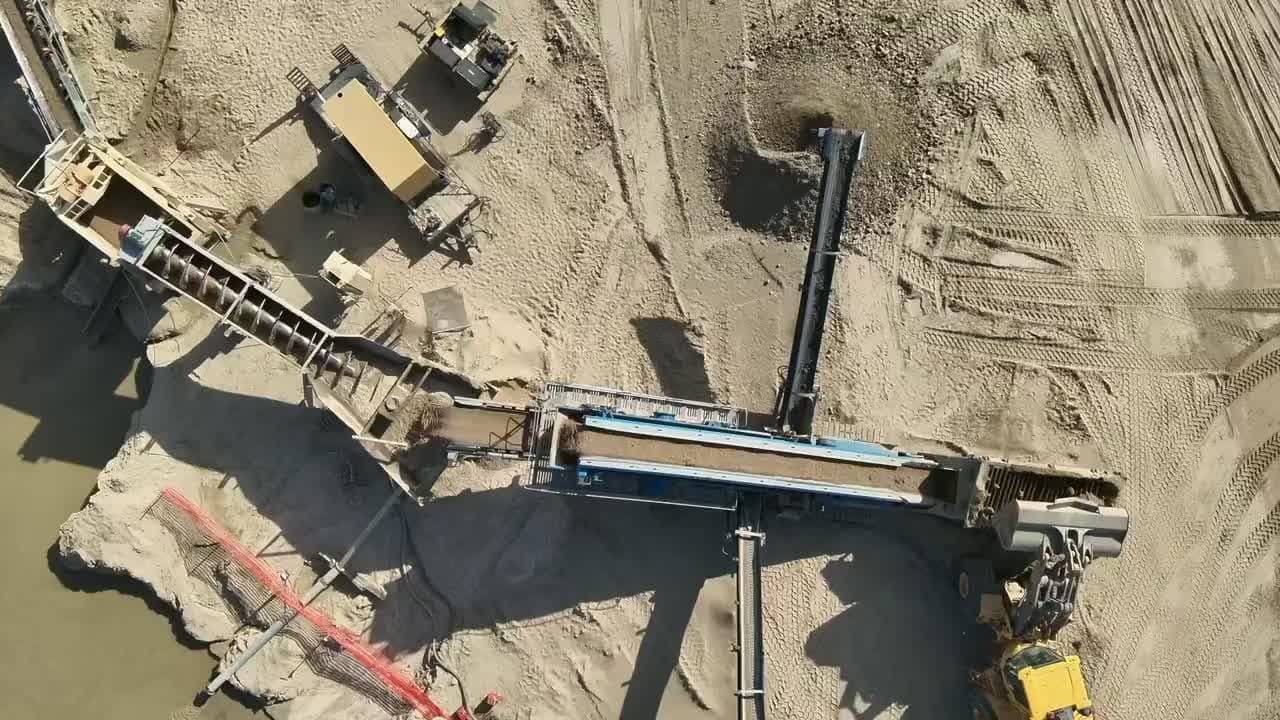
A stationary plant can make sense for a long-life quarry with high volume and consistent market demand. It may include permanent crushers, screens, surge piles, wash circuits, conveyors, silos, truck scales, offices, shops, and rail loadout.
A portable or semi-mobile plant may make sense for shorter-term deposits, contract crushing, smaller sites, or operations that need to move within a property or between sources.
A mobile plant can reduce haul distance inside the pit or quarry by moving closer to the face, but it may have different capacity, maintenance, and product-control tradeoffs.
The plant type should match the deposit, product list, volume, capital budget, permitting limits, and market.
Process Flow
Process flow is the sequence that turns raw material into finished products.
A crushed stone plant might include:
- Drilling and blasting.
- Loading and hauling shot rock.
- Primary crushing.
- Scalping or pre-screening.
- Secondary crushing.
- Tertiary crushing or shaping.
- Screening.
- Washing or classifying.
- Conveying.
- Stockpiling.
- Loadout and weighing.
A sand and gravel plant might include excavation or dredging, screening, washing, classifying, dewatering, blending, and stockpiling.
The process flow is designed backward from products. If the market needs clean concrete stone, concrete sand, road base, and riprap, the plant must be able to make those products consistently.
Product Mix And Waste Balance
A quarry cannot sell only the perfect size if the process also creates other sizes.
Crushing and screening produce a mix of coarse stone, intermediate products, screenings, fines, and sometimes oversize. If the market demands mostly one product, the operation may build surplus inventory of another. Manufactured sand, base products, and blending can help use fines and screenings that might otherwise become low-value stockpiles.
A strong quarry plan considers product balance:
- What products will the market absorb?
- Which products are high value?
- Which products move slowly?
- Can screenings become manufactured sand?
- Can fines be used in base?
- Is washing needed to make saleable sand?
- Will any material become waste?
The best deposit is one where geology, process, and market work together.
Quality Control
After startup, quality control keeps products consistent.
Producers use sampling, sieve analysis, product testing, crusher setting checks, screen inspections, moisture checks, stockpile controls, and source tracking. If a ledge changes or a screen wears, gradation can shift. If a stockpile segregates, one load may be different from the next.
Quality control is not only for agency projects. It is what keeps a product reliable for every customer.
Why Local Sources Matter To Delivered Price
Delivered aggregate price is heavily affected by freight. A source 10 miles away can often beat a source 60 miles away even if the distant source has a lower pit price. The truck, driver, fuel, time, legal weight, and return trip all matter.
This is why FlintEdge pricing depends on product availability near the delivery ZIP code. The nearest source for base rock may not be the nearest source for decorative stone or washed sand.
Local geology and local supply points shape what products are available at competitive delivered prices.
Overburden Can Make Good Rock Uneconomic
Overburden is the soil, weathered rock, and other material above the usable aggregate. It has to be removed, handled, stored, or used in reclamation before the saleable reserve can be mined.
Thick overburden can make an otherwise good deposit uneconomic. Every foot of overburden increases stripping cost and may reduce the amount of usable rock recovered from the property. Overburden also affects stormwater controls, reclamation planning, screening berms, topsoil salvage, and the sequence of mining.
For sand and gravel pits, overburden may include topsoil, clay, silt, or unsuitable layers. For bedrock quarries, the top of the rock may be weathered, fractured, or contaminated with soil. That upper zone may not produce the same quality aggregate as the deeper ledges.
A site-selection study therefore asks not only "How much rock is there?" but "How much saleable aggregate can be recovered after overburden, setbacks, benches, water, and waste are accounted for?"
Water Table And Wash-Water Planning
Water can help or hurt an aggregate operation depending on the site and product.
In sand and gravel deposits, groundwater may be close to the surface. Some operations excavate above the water table, while others dredge or mine wet. Wet mining changes equipment choices, slope stability, processing flow, and reclamation. It may also trigger additional water permits or monitoring.
In crushed stone quarries, groundwater can enter through fractures, bedding planes, or deeper excavation. Pumping, sumps, settling areas, and discharge controls may be needed. If a wash plant is used, the site also needs a water source and a way to manage dirty wash water.
Wash-water planning matters because washed products can be valuable. Concrete sand, washed stone, mason sand, and clean decorative products may require water processing. If the site has no practical water plan, the product mix may be limited even if the deposit itself is good.
Community Fit Is A Real Site-Selection Factor
Aggregate is essential, but quarries and pits are not invisible.
Neighbors may care about truck traffic, dust, noise, blasting vibration, hours of operation, lights, views, property values, road wear, water, and reclamation. Local governments may require hearings, setbacks, berms, landscaping, road agreements, operating-hour limits, or monitoring.
A technically strong deposit can still be a poor site if the surrounding land use is incompatible or if truck routes create unacceptable impacts. A more remote site can reduce neighbor conflicts but increase freight cost. A site close to a market can reduce delivered cost but face more intense land-use pressure.
Good site selection evaluates this early. It is better to identify community and access constraints before spending heavily on exploration, plant design, and permitting.
Reclamation Starts Before Mining
Reclamation is the planned post-mining use and stabilization of the site.
A quarry or pit may eventually become a lake, wetland, industrial site, recreation area, pasture, wildlife area, or other land use depending on the deposit, water table, surrounding land, and permit conditions. Reclamation planning can influence where overburden is stored, how slopes are built, how drainage is handled, and how the operation phases mining.
For sand and gravel pits, reclamation may include graded slopes, ponds, revegetation, or habitat features. For bedrock quarries, reclamation may include highwall stabilization, benches, water management, and final access control.
Reclamation is not just a final cleanup item. It affects the mining plan from the beginning.
Product Testing Must Match The Intended Market
Testing every source for every possible use is not always practical. The testing program should match the intended products and customers.
If the market is local driveway base, the key questions may be gradation, plasticity, compaction behavior, durability, and whether the product can be made consistently. If the market is concrete aggregate, the testing shifts toward gradation, soundness, abrasion, absorption, deleterious materials, organic impurities for sand, and chemical compatibility. If the market is asphalt, angularity, durability, gradation, polish resistance, and agency approval may matter.
Decorative products add appearance and color consistency. Drainage products add cleanliness and open-graded behavior. Riprap adds size, durability, shape, and handling concerns.
A quarry site is stronger when the source can produce products the market actually needs and the tests support those uses.
The Plant Is Designed Backward From Products
A quarry plant is not chosen by copying another quarry. It is designed backward from the deposit and the product list.
If the source rock is hard and abrasive, crusher selection and wear costs matter. If the deposit produces excess fines, the plant may need better screening, manufactured sand processing, or a base market that can absorb screenings. If the market needs washed products, water and classification equipment matter. If the market needs riprap, the operation needs a way to handle large stone safely without forcing all material through the crushing circuit.
The plant also has to balance capacity. A primary crusher that feeds more tons than the screens can handle creates bottlenecks. A wash plant that cannot keep up with sand production limits saleable washed sand. Stockpile space must match product variety and inventory needs.
Good plant design turns geology into a product system. Poor plant design creates piles of material the market does not want.
Why Some Deposits Need Blending
Natural deposits rarely match every product requirement exactly. A pit may have one zone that is too sandy and another that is too coarse. A quarry may have ledges that produce different amounts of screenings. A manufactured sand may need to be blended with natural sand. A base product may need additional fines or a cleaner coarse fraction.
Blending can turn variable source materials into a consistent product, but only within limits. If none of the source zones contain the missing size, blending cannot invent it. If all zones contain too much clay, blending them together will not remove the clay. If one ledge fails a durability requirement, it may not be acceptable in a high-spec product even if the gradation works.
This is why exploration, plant design, and quality control are connected. A site with multiple usable fractions and enough processing flexibility can serve more markets.
Why Some Quarries Produce Different Products Over Time
Product availability can change as a quarry advances.
The operation may move from one ledge to another. The weathered cap may be removed. A new bench may expose cleaner rock or more fractured material. A sand and gravel pit may move from a coarse zone into a finer zone. A market shift may make one product more important than another. A new screen, crusher, wash plant, or classifier can change what the source can produce economically.
That does not mean the quarry is inconsistent by default. It means aggregate production is tied to a real geologic deposit. Good operations track these changes and adjust quality control, blending, and product planning.
For customers, this explains why a product should be tied to current availability and source data rather than assuming last year's pile is always identical.
Why Permitted Reserves Have Strategic Value
A permitted aggregate reserve close to a growing market can be extremely valuable because new sources are hard to open.
The rock may be common geologically, but permitted access to that rock is not always common. Urban growth can cover deposits with houses, roads, utilities, and incompatible land uses. Environmental constraints can restrict mining. Local opposition can delay or prevent approvals. Long haul distances increase delivered costs for everyone.
This is one reason protecting local aggregate resources matters. If nearby reserves are lost, the market still needs stone, sand, and gravel. The material just travels farther, increasing truck traffic, cost, fuel use, and delivery complexity.
Common Site-Selection Red Flags
Some properties look promising on a map but weaken quickly under due diligence.
Common red flags include:
- Thin or inconsistent reserves.
- Too much overburden.
- High clay, shale, organics, or deleterious material.
- A water table that conflicts with the proposed mining method.
- Poor road access or unsafe truck routes.
- Nearby incompatible land uses.
- Wetlands, floodplain, or habitat constraints that sharply reduce mineable area.
- Zoning that does not support extraction.
- No practical place for stockpiles, scales, ponds, berms, or plant equipment.
- Product testing that does not match the target market.
- A product balance that creates too much slow-moving material.
Any one of these issues may be manageable. Several together can make a site uneconomic even if the raw aggregate exists.
What A Good Quarry Site Does Well
A strong site usually aligns five things.
First, it has a deposit that can make saleable products, not just a large volume of material. Second, it has enough mine life to justify the investment in permits, plant, roads, scales, and reclamation. Third, it has access to a market that can absorb the product mix. Fourth, it can be permitted and operated with manageable environmental and community impacts. Fifth, the plant can be designed so the operation makes the right sizes without creating unsold waste.
When those five conditions line up, the quarry can support local construction for years. When they do not, the operation may struggle with cost, quality, inventory, or permitting from the start.
Why This Matters To Buyers
Most customers do not need to evaluate quarry sites. But understanding the process explains why aggregate supply is regional and why delivered pricing changes by product.
The clean stone, base rock, sand, or decorative rock available in a ZIP code reflects the deposits that are permitted, processed, and close enough to haul economically. A product that is common in one region may be expensive or unavailable in another. A spec material may come from a farther source because the nearby source cannot meet the test requirements.
Quarry selection is upstream of the price shown to the buyer. Geology, permits, plant design, product testing, stockpiles, and trucking all shape what can be delivered.
The Bottom Line
Choosing an aggregate quarry site requires more than finding rock.
A good site needs:
- Market demand.
- Suitable geology.
- Enough mineable reserves.
- Test results that support saleable products.
- Practical transportation access.
- Permitting feasibility.
- Environmental controls.
- A plant design matched to the product mix.
- Quality-control systems.
That is why aggregate supply is regional. The products delivered to a job site are the result of geology, engineering, permitting, processing, and trucking all working together.